Recognition Without Territory: A Legal Pathway for Digital Jurisdictions
- Oleg Manyuta

- Mar 21
- 4 min read
Updated: Mar 22

From the Order of Malta to DAOs and portable sovereignty

ABSTRACT
This article explores whether legal recognition of a state or jurisdiction can exist independently of territorial control. Drawing on the Montevideo Convention criteria and key international jurisprudence, including ICJ advisory opinions, it argues that recognition is increasingly decoupled from territory in contemporary international law. The paper further examines the implications of this shift for emerging digital jurisdictions and forms of extraterritorial sovereignty, suggesting that the legal framework may already contain the foundations for recognising non-territorial entities in the digital age.
1. Introduction
Modern public international law rests on a foundational assumption: that sovereignty is territorially anchored.¹
Jurisdiction presupposes a defined geographical space within which authority is exercised.² Yet this assumption is increasingly strained by the emergence of digital systems that operate beyond territorial constraints.
Decentralised governance structures, digital identity frameworks, and mobile populations now organise economic and social life independently of location. These systems function, coordinate, and regulate - but remain legally ambiguous.
The central question is therefore no longer whether non-territorial systems can exist. They already do.
Rather, the question is: under what conditions can such systems be recognised as subjects of law?
2. Recognition in classical international law
Recognition has traditionally been understood through two competing doctrines:
the constitutive theory, under which an entity becomes a subject of international law only upon recognition by existing states;³
the declaratory theory, which holds that statehood depends on objective criteria, most famously articulated in the Montevideo Convention.⁴
Article 1 of the Montevideo Convention defines a state as possessing:
a permanent population
a defined territory
government
capacity to enter into relations with other states⁵
Although often presented as objective, these criteria are deeply territorial in nature.⁶
The jurisprudence of the International Court of Justice reinforces this structure, linking legal personality to participation within the international legal order.
In Reparations for Injuries, the Court held that international personality arises from the ability to possess rights and duties and to bring claims on the international plane.⁷
This formulation, while not strictly territorial, assumes institutional recognition within an existing system.
3. The exception: sovereignty without territory
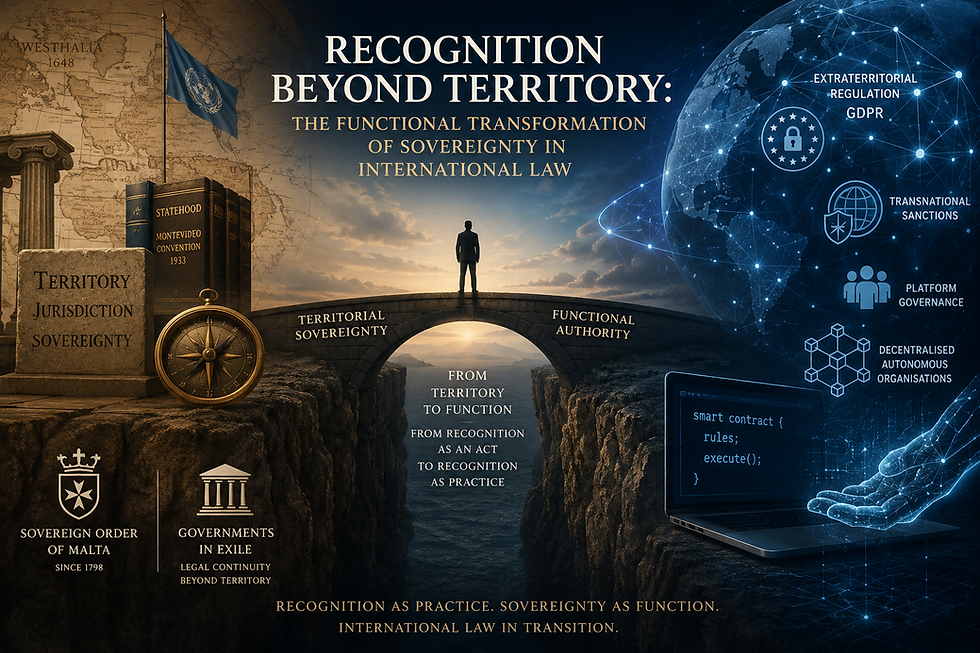
The Sovereign Order of Malta represents a notable exception.
Despite lacking a defined sovereign territory, it:
maintains diplomatic relations with over 100 states
issues passports
exercises functional legal personality
Its status has been described as anomalous but operationally recognised.⁸
This suggests an alternative principle: sovereignty may derive from function, continuity, and recognition, rather than territory alone.
4. Digital systems as proto-jurisdictions
Emerging digital systems increasingly exhibit characteristics associated with governance:
Decentralised Autonomous Organisations (DAOs)
self-sovereign identity (SSI) frameworks
blockchain-based governance protocols
These systems can:
define membership
establish internal rules
coordinate economic activity
In functional terms, they resemble proto-jurisdictions.
Yet, in legal terms, they remain unrecognised.
5. The recognition gap
The divergence between functionality and recognition constitutes the central legal problem.
Digital systems may satisfy analogues of governance, population (users or token holders), normative frameworks.
However, they lack territorial anchoring and formal recognition by states.
This creates a structural paradox: entities capable of governance may nonetheless lack legal personality.
6. Case law and the limits of territorial thinking
The jurisprudence of the International Court of Justice reveals both the rigidity and flexibility of international law.
In the Kosovo Advisory Opinion, the Court confirmed that international law contains no general prohibition on declarations of independence.⁹
This suggests that legal personality is not strictly dependent on territorial legality at the moment of emergence.
In Nottebohm, the Court emphasised the requirement of a “genuine link” between an individual and a state for nationality to be opposable internationally.¹⁰
This introduces a relational dimension to legal status - one not purely territorial.
Taken together, these cases indicate that recognition is shaped not only by territory, but by function, connection, and acceptance.
7. Towards a non-territorial recognition doctrine
To address the recognition gap, it is necessary to reconsider the criteria for legal personality.
A non-territorial entity might qualify for recognition where it demonstrates:
(1) Functional governance
The ability to create and apply rules.
(2) Persistent identity infrastructure
A stable system of identifying participants.
(3) Normative coherence
Consistent and transparent governance structures.
(4) External legal interface
Capacity to interact with recognised legal actors.
(5) Emergent recognition
Gradual acceptance through practice, rather than formal declaration.
8. From territory to identity
The most significant conceptual shift lies in the relocation of jurisdictional anchoring from territory to identity.
This is reflected in emerging systems such as digital identity infrastructures, mobile governance models, non-fixed address frameworks.
The No Fixed Address (NFA) concept illustrates this shift by proposing a system in which identity remains constant, location is dynamic, address becomes a function of data.
As documented in its underlying research, such systems aim to enable individuals without fixed residence to participate in legal and economic life.
9. Risks and structural tensions
The recognition of non-territorial jurisdictions raises significant concerns:
fragmentation of legal order
regulatory arbitrage
diminished accountability
concentration of private power
Moreover, the erosion of territoriality may undermine safeguards historically associated with state-based governance.¹¹
10. Pathways to recognition
Recognition of digital jurisdictions is unlikely to occur through a single doctrinal shift.
Instead, it may emerge through:
sectoral recognition (e.g., financial regulation)
hybrid governance arrangements
contractual integration with state systems
gradual normative acceptance
This reflects the evolutionary nature of international legal personality.¹²
11. Conclusion
The international legal system is not yet prepared to recognise fully non-territorial jurisdictions.
However, it is increasingly required to engage with them.
The experience of the Sovereign Order of Malta demonstrates that:
territory is not an absolute prerequisite for legal personality.
Digital systems now test whether that principle can be extended.
Final reflection
Sovereignty may no longer be something exercised over land alone.
It may become something exercised through systems and recognised through practice.
References
Malcolm N Shaw, International Law (9th edn, CUP 2021) 362.
James Crawford, Brownlie’s Principles of Public International Law (9th edn, OUP 2019) 447.
Hersch Lauterpacht, Recognition in International Law (Cambridge University Press 1947) 38.
Crawford (n 2) 115–118.
Montevideo Convention on the Rights and Duties of States (1933) 165 LNTS 19, art 1.
Shaw (n 1) 365.
Reparations for Injuries Suffered in the Service of the United Nations (Advisory Opinion) [1949] ICJ Rep 174.
Crawford (n 2) 219.
Accordance with International Law of the Unilateral Declaration of Independence in Respect of Kosovo (Advisory Opinion) [2010] ICJ Rep 403.
Nottebohm (Liechtenstein v Guatemala) (Second Phase) [1955] ICJ Rep 4.
Shaw (n 1) 489.
Crawford (n 2) 128–130.


Comments