Russia Without Territory Is Not a Fantasy — It’s the Future


The idea of a “Russian Taiwan” is spreading among opposition thinkers. It sounds strategic, even inevitable: a democratic Russia in exile, waiting for its return.
It is also intellectually outdated.
The concept assumes that sovereignty must be territorial — that political legitimacy requires land, borders, and a place on the map. That without territory there can be no state, only rhetoric.
This assumption is comforting.
It is also wrong.
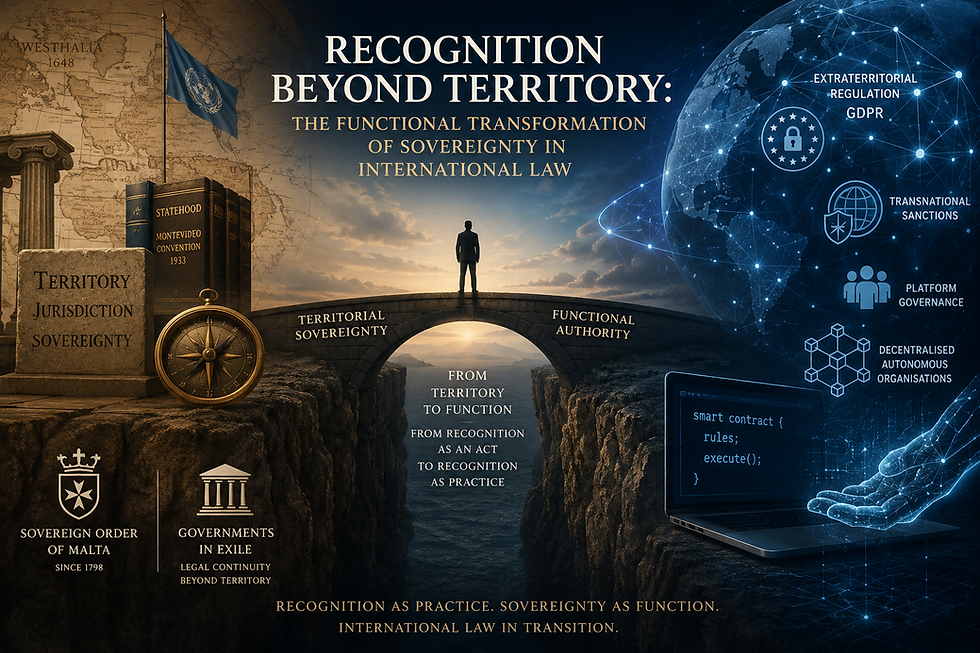
International law has never fully obeyed this logic. Entities have exercised sovereignty without territory for centuries. The Sovereign Order of Malta has operated as a recognised subject of international law since losing its land in 1798. The Holy See maintained international personality before the Vatican had territorial form. Governments in exile have preserved legal continuity without controlling borders.
These are not historical curiosities.
They expose a deeper truth: sovereignty is not a place. It is a structure of recognition.
And that structure is already changing.
The debate about Russia’s future is trapped in twentieth-century thinking. It looks for territory — an island, a base, a safe jurisdiction — because it cannot imagine sovereignty without geography.
But geography is no longer the decisive factor.
Across the world, systems of governance are emerging that do not depend on land. Digital identity frameworks allow individuals to participate in legal and financial systems without fixed residence. Decentralised organisations coordinate decisions across borders. Blockchain-based systems enforce rules without a central authority.
These systems are dismissed as experimental.
They are not.
They already perform core functions of governance: identity, coordination, enforcement.
What they lack is not capacity.
It is recognition.
This is the real fault line of modern sovereignty: not between states and non-states, but between entities that function and entities that are recognised.
A post-Putin Russian political community is unlikely to resemble a government in exile. It will not control territory. It will not command borders. It may not even try.
What it will have — if it is to matter — is something else:
a distributed community,
a persistent legal identity,
a system of governance operating across jurisdictions.
In other words, a polity without land.
This is not a theoretical scenario. It is already visible in fragments.
Millions of Russians have left the country since 2022. Many exist in a legal grey zone: unable to integrate fully into host states, but unwilling to remain tied to the Russian state. They are, in effect, a dispersed political body without a recognised legal form.
The “Russian Taiwan” proposal tries to solve this by recreating an old model: find territory, build a state, wait for history.
But the real challenge is different.
It is to create a system that can be recognised before it has territory — or without it altogether.
Recognition will not come as a single diplomatic act. It will emerge through use: documents accepted, agreements signed, institutions engaged. Through practice, not proclamation.
This is how sovereignty has always evolved.
The uncomfortable implication is this: the future of political legitimacy may no longer depend on land at all.
Not entirely.
But decisively less than before.
For policymakers, this changes the problem. Supporting a democratic Russian alternative is not about allocating territory or hosting a government in exile. It is about enabling recognition: legal status, documentation, financial access, institutional interaction.
In other words, the problem is not geographic.
It is juridical.
The idea of a “Russian Taiwan” looks in the wrong place because it looks at the map.
The real transformation is happening off the map.
The next form of Russia — if it emerges — will not begin with borders.
It will begin with recognition.
And by the time it is recognised, it may already be functioning as one.


Comments